What to Do If You See a Coyote
By CoyoteBytes Editorial TeamChecked by CoyoteBytes Editorial TeamReview date First published Filed under Encounters & Reporting
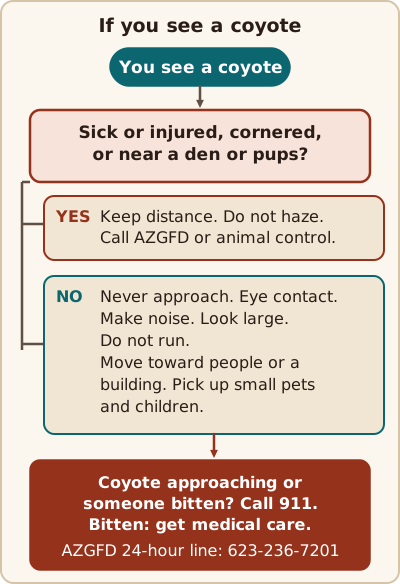
If you see a healthy coyote that keeps its distance, extension sources describe hazing: loud noises, waving your arms or a broom. Never haze a coyote that looks sick, is cornered, or may have pups: keep your distance and call. After any bite or scratch, wash the wound and get medical care urgently.
This is general information, not veterinary, medical or legal advice. For an injured or aggressive animal, a bite, a pet attack or a suspected rabies exposure, call your doctor, your vet, local animal control, or the Arizona Game and Fish Department (AZGFD).
Reviewed by the editorial desk against the cited sources. The desk holds no wildlife-biology, veterinary or medical credential; see our editorial policy.
Most coyote sightings need nothing more than distance. This hub explains what to do when you see one, what the extension and agency sources say about hazing, when not to haze, and what to do about a bite or a sick animal. For prevention at home, see the yard and home guide; for numbers to call, see Who to Call About Coyotes in Pima County and Arizona; for pets, see Protect Pets and Children from Coyotes.
If the coyote looks healthy and is keeping its distance
University of Arizona Cooperative Extension says AZGFD recommends helping wild animals keep their natural fear of people. The deterrents it lists for unwanted wildlife near a home are: make loud noises (shout, bang pots and pans, or rattle an empty can with pebbles in it), wave your hands or an object such as a broom. This is what agencies call hazing: making the animal uncomfortable around people so it leaves. UC IPM warns that sounds alone only work briefly, because coyotes quickly adapt when there is no real threat.
When not to haze: keep your distance and call
Do not haze a coyote that looks sick, is cornered, or may be protecting a den or pups. Never use anything that could injure the animal. AZGFD’s August 2025 bulletin describes the signs that point to a sick animal: little fear of people, stumbling, seizures, and discharge from the eyes and nose. It says to avoid approaching or touching wildlife and to report sick or dead animals to AZGFD, and that distemper cannot be told from rabies by symptoms, so sick animals should be treated as potentially rabid. Pima County says wild animals that are not afraid of people are abnormal and should be avoided.
Keep pets and children close
Pick up small pets, keep dogs close and leave the area. Do not let a dog approach a coyote. The pet and child guide has more.
If someone is bitten or scratched
The CDC advises washing any wound right away with soap and water (its prevention page says for 15 minutes) and seeking medical care urgently, because treatment starts with wound care, rabies immune globulin and a series of vaccines, and works best when started soon. Tell your provider what type of animal was involved and whether it was acting abnormally. Contact your health department or a healthcare provider immediately. Do not wait to see whether symptoms appear. Also contact local animal control; in Pima County that is Pima Animal Care Center at 520-724-5900, option 4.
If your pet has contact with a wild animal
See your veterinarian and call Pima Animal Care Center. Pima Animal Care Center’s 2021 release says the pet should get a rabies booster at the vet and that the call goes to Animal Protection at 520-724-5900, option 4.
Rabies, in CDC wording
The CDC says rabies is a fatal but preventable viral disease affecting the brain and nervous system, spreading primarily through bites or scratches from an infected animal. It names bats, raccoons, skunks and foxes as the animals most often found with rabies. The CDC also says to keep your distance from wildlife, not to approach animals that seem injured, sick or dead, and to call animal control for help instead.
Do not feed, trap, poison or relocate
Feeding or enticing wildlife is covered by A.R.S. 13-2927 in Maricopa, Pinal and Pima counties (checked on 2026-11-14; confirm with AZGFD). We do not describe trapping, poisoning, shooting or relocating wildlife. University of Arizona Cooperative Extension warns that pesticides and rodenticides can kill non-target wildlife, including coyotes.
Report it
For what to say and who to tell, see Submit a sighting report.
AZGFD’s steps for an encounter
AZGFD’s Living with Coyotes page says coyotes are usually timid and run if challenged, and that people should act assertively to help them keep their fear of humans (AZGFD, accessed 2026-11-14). Its steps include:
- Never approach a coyote.
- Keep eye contact, and do not turn and run.
- Scare it off with loud noises: shouting, a whistle, loud music, banging pots and pans, or a “coyote shaker”, a soda can with pebbles in it.
- Wave your arms or a broom to look larger.
- Leash pets, and pick up small pets and children.
- Move toward people, buildings or activity.
AZGFD lists additional deterrents too; this guide focuses on noise, size and distance. Do not haze a coyote that looks sick, is cornered, or may be guarding a den or pups. Keep your distance and call.
Why people matter
AZGFD says the risk rises when coyotes are fed or when people react with indifference, and that human-fed coyotes have on rare occasions bitten people (AZGFD). Its April 2023 release counted 24 coyote attacks on people in the Phoenix metro area in the previous 26 years (AZGFD tips release). Attacks are uncommon, but treat a coyote that approaches people as a call.
Emergency numbers
If a coyote is approaching or has bitten a person, call 911 and seek medical care immediately for any bite; AZGFD’s 24-hour Communications Center for wildlife acting aggressively toward people is 623-236-7201 (AZGFD tips release).
The local AZGFD office is staffed 8 to 5, Monday to Friday; after hours and on weekends the dispatcher is at 623-236-7201 (AZGFD).
Will AZGFD remove the coyote?
AZGFD does not respond to calls to relocate or remove coyotes unless there is a public-safety concern. Coyotes that attacked people or show predatory or aggressive behavior toward them are lethally removed only as a last resort (AZGFD tips release). Removing a coyote does not help if attractants remain, so see the yard and home guide.
Feeding is unlawful
Feeding wildlife (except birds and tree squirrels) is unlawful in Maricopa, Pinal and Pima counties under A.R.S. 13-2927, according to AZGFD’s April 2023 tips release; some cities and counties have their own ordinances, so check local rules and confirm with AZGFD (checked on 2026-11-14).
All Encounters guides
- What to Do if You Encounter a Coyote, by Situation
Steps for each coyote encounter: at a distance, following you, near your dog, in your yard, sick or near a den, plus who to call and what not to do.
Frequently asked questions
What should I do if I see a coyote in my yard?
University of Arizona Cooperative Extension says AZGFD recommends helping wild animals keep their fear of people: make loud noises, wave your hands or an object such as a broom. Do this only if the coyote looks healthy and is not cornered. Keep pets and children inside while you do.
When should I not haze a coyote?
Do not haze a coyote that looks sick, is cornered, or may be guarding a den or pups. Keep your distance and call AZGFD or Pima Animal Care Center. AZGFD's 2025 bulletin says signs of illness include little fear of people, stumbling, seizures and eye or nose discharge, and says to avoid approaching or touching wildlife.
What do I do if a coyote bites or scratches me?
The CDC says to wash the wound right away with soap and water and seek medical care urgently. Treatment includes wound care, rabies immune globulin and a series of vaccines, and works best when started soon. Tell your provider what animal was involved and whether it was acting abnormally, and also contact local animal control.
Does a coyote bite always mean rabies?
No. The CDC names bats, raccoons, skunks and foxes as the animals most often found with rabies. But rabies spreads through bites and scratches and is nearly always fatal once symptoms appear, so the CDC says not to wait. Call your doctor or health department after any bite or scratch from a wild animal.
What if my dog fights with a coyote?
Get veterinary attention for any injury, then call Pima Animal Care Center at 520-724-5900, option 4. The center's 2021 release says a pet that has contact with wildlife should get a rabies booster from a vet. Observation or quarantine rules depend on vaccination status, so confirm the current rules when you call.
Can I trap, relocate or shoot a coyote that keeps coming back?
This site gives no instructions for trapping, relocating, poisoning or shooting wildlife. Rules vary, and the sources we could open did not cover them. Call AZGFD and ask what is lawful at your address before you act. Removing food and water attractants is the step the agencies and extension sources stress.
Sources
- University of Arizona Cooperative Extension: Preventing Dangerous Interactions with Wildlife (AZ1481d) (extension.arizona.edu)
- UC IPM Pest Notes: Coyote (UC ANR Publication 74135, updated March 2007) (ipm.ucanr.edu)
- AZGFD bulletin: AZGFD urges vigilance during canine distemper outbreak (12 Aug 2025) (content.govdelivery.com)
- CDC: About Rabies (cdc.gov)
- CDC: Rabies Prevention and Control (cdc.gov)
- Pima Animal Care Center: Wildlife making appearances around Pima County (11 Mar 2021) (oldcms.pima.gov)
- Pima County: Health department reminder: Avoid rabies by staying away from wildlife (17 Mar 2022) (oldcms.pima.gov)
- University of Arizona Cooperative Extension: Pesticide Use and Wildlife (AZ1481i, October 2009) (extension.arizona.edu)
- Arizona Revised Statutes 13-2927 (unlawful feeding of wildlife) (azleg.gov)
- Arizona Game and Fish Department: Living with Coyotes (accessed 2026-11-14) (azgfd.com)
- Arizona Game and Fish Department: TIPS to avoid conflicts with coyotes (7 Apr 2023; accessed 2026-11-14) (azgfd.com)
Related guides
- What to Do if You Encounter a Coyote, by Situation
Steps for each coyote encounter: at a distance, following you, near your dog, in your yard, sick or near a den, plus who to call and what not to do.
- Coyote Aggressive Behavior: Warning Signs
Warning signs of bold or aggressive coyote behavior in Arizona, what the agencies say causes it, and the calm steps to take and who to call.
- Coyote Encounter Checklist
A coyote encounter checklist for Arizona residents: steps for a coyote nearby, following you, near your pet, at your door or sick, plus who to call.
- Coyote Hazing Methods Agencies Recommend
How AZGFD describes scaring a coyote: noise, looking large, eye contact, backing toward people. Plus when NOT to haze: sick, cornered or denning coyotes.
- Mange and Sick-Looking Coyotes: Who to Call
A coyote that looks sick or mangy in Arizona: keep your distance, do not feed or approach it, and know when to call AZGFD, animal control or a doctor.
- Rabies and Coyotes: What the CDC Says
Rabies and coyotes in Arizona, using CDC and Arizona DHS wording: how it spreads, warning signs, and what to do after any bite, scratch or pet contact.