Manage and Protect Arizona Homes from Urban Coyotes
By CoyoteBytes Editorial TeamChecked by CoyoteBytes Editorial TeamReview date First published Revised
To protect an Arizona home from urban coyotes, remove what attracts them: unsecured garbage, pet food, spilled bird seed, fallen fruit, compost and standing water. Supervise pets outdoors, never feed wildlife, and call Pima Animal Care Center or AZGFD for sick, injured or aggressive animals instead of handling the problem yourself.
This is general information, not veterinary, medical or legal advice. For an injured or aggressive animal, a bite, a pet attack or a suspected rabies exposure, call your doctor, your vet, local animal control, or the Arizona Game and Fish Department (AZGFD).
Reviewed by the editorial desk against the cited sources. The desk holds no wildlife-biology, veterinary or medical credential; see our editorial policy.
CoyoteBytes is a plain-language guide to living with urban coyotes in Green Valley, Pima County and elsewhere in Arizona. This page covers the yard and home side: what draws coyotes to a property, what residents can change, and where the line is between a normal sighting and a call to the authorities. Start with the hubs below for the rest.
Where to go next
- Start Here: Coyotes in Green Valley and Pima County is the orientation page.
- Coyote Information for Arizona Homeowners covers what coyotes are and why they turn up in neighborhoods.
- Protect Pets and Children from Coyotes in Arizona covers pets, children and outdoor routines.
- What to Do If You See a Coyote covers encounters, hazing and health risks.
- Who to Call About Coyotes in Pima County and Arizona lists the agencies and phone numbers.
- File a sighting report explains how to report one.
Why coyotes show up near homes
Coyotes are common visitors to neighborhoods around Tucson. Pima County’s urban wildlife page lists coyotes, bobcats and javelina as common visitors to Tucson-area neighborhoods. The University of Arizona Cooperative Extension adds that attacks on people usually occur when animals associate people with food, and that these negative encounters are usually set in motion by people. That is why most of the useful steps for a homeowner are about removing what attracts wildlife, not about the animal itself.
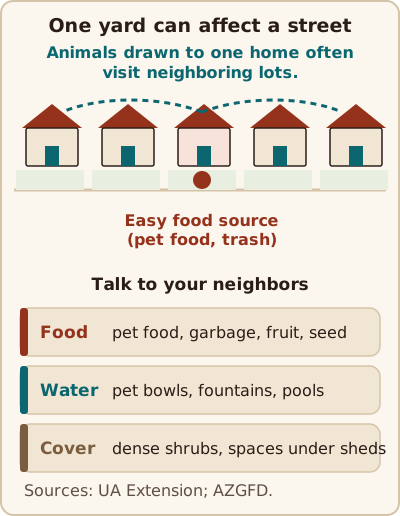
The same extension publication notes that javelina, elk, bobcats and coyotes that are attracted to one home often visit neighboring lots. A single yard with an easy food source can affect a whole street, so talking to neighbors matters as much as what you do on your own lot.
Remove food and water attractants
University of Arizona Cooperative Extension and UC IPM (the University of California’s statewide integrated pest management program, which publishes a coyote Pest Note) give a consistent list of attractants to deal with:
- Feed pets indoors, or remove leftover pet food from outdoors immediately, and store pet food securely.
- Store garbage securely, in cans with tight lids, so coyotes and other wildlife cannot get to edible waste.
- Keep bird seed and water off the ground and out of reach of wildlife. Extension suggests a platform under feeders to catch spilled seed and putting out only the seed birds can eat in a short time.
- Pick fruit before it falls, and avoid fruiting plants in the landscape where you can.
- Contain compost and fence garden plots.
- Remove standing water.
- Prune the lower limbs of shrubs and small trees to a height of 2 feet (UC IPM), so there is less cover close to the ground.
Do not feed coyotes or leave food out for them on purpose. See the rules section below.
Fencing
UC IPM describes a coyote-resistant fence as at least 5½ feet tall, with mesh no larger than 6 inches, and a wire apron buried 4 to 6 inches deep that extends at least 15 inches outward to discourage digging. That is a California extension publication and the figures are for livestock and property protection; the University of Arizona and AZGFD materials we could open did not give fence measurements for Arizona yards. Treat the numbers as one extension source’s guidance, and ask AZGFD or a local fencing professional what suits your lot.
Pets in the yard
Both extension sources are direct about pets. University of Arizona Cooperative Extension says to supervise your pets outdoors and not let them roam freely, because they may end up as a meal for coyotes, hawks, owls, bobcats and other predators. UC IPM advises keeping small pets indoors or in enclosed kennels and bringing large dogs in after dark. The pets and children guide goes into more detail.
Hazing at home: what extension describes
University of Arizona Cooperative Extension says AZGFD recommends helping wild animals keep their natural fear of people. Its list of deterrents for an unwanted animal near your home is: make loud noises (shout, bang pots and pans, or rattle an empty can with pebbles in it), wave your hands or an object such as a broom. UC IPM adds that sound and visual deterrents only work briefly, because coyotes quickly adapt to sounds when there is no real threat, and that no chemical repellents are registered for coyotes.
Do not haze an animal that looks sick, is cornered, or may be protecting a den or pups. Keep your distance and call. The encounter guide explains why.
Do not poison or trap
This site does not give instructions for trapping, poisoning, relocating or otherwise harming coyotes. University of Arizona Cooperative Extension warns that pesticides and rodenticides can kill non-target animals, including coyotes, and a coyote can be harmed by eating bait or by eating prey that carries poison. If you have a coyote problem you cannot solve with the steps above, call AZGFD or Pima Animal Care Center before doing anything else.
What the rules say
Checked on 2026-11-14. Arizona Revised Statutes 13-2927 makes it a petty offense to intentionally, knowingly or recklessly feed, attract or entice wildlife into an area, with listed exceptions (for example lawful taking under title 17, public employees acting within their authority, normal agricultural or livestock practices, and tree squirrels or birds). The section applies in counties with a population of more than 280,000. Confirm with AZGFD whether it applies where you live and what else the rules say. Read the statute and the AZGFD living with coyotes page.
When to call someone
Call Pima Animal Care Center at 520-724-5900, then press 4, for a sick or injured animal, or if your pet has had contact with a wild animal. See a doctor right away after any bite or scratch. The who to call page has the full list, and the rabies steps follow CDC wording.
What AZGFD says in brief
AZGFD says coyotes are common in rural and suburban Arizona, that they are usually timid, and that the risk rises when they are fed or met with indifference (AZGFD, Living with Coyotes, accessed 2026-11-14). It describes them as medium-sized, doglike canids of about 20 to 30 pounds in Arizona that mate from January to March and have 4 to 7 pups in a den from March to May. They eat rabbits, rodents, birds, snakes, insects, fruit and carrion, and in cities garbage and ornamental fruit.
AZGFD’s attractant list is food (pet food, garbage, fallen fruit and the animals that coyotes hunt), water (pet bowls, fountains, pools) and shelter (dense shrubs, storm drains, space under sheds and porches). It says a 6-foot fence is not reliable, because coyotes are skilled jumpers, and that small pets belong indoors or in a roofed enclosure.
Feeding wildlife (except birds and tree squirrels) is unlawful in Maricopa, Pinal and Pima counties under A.R.S. 13-2927, according to AZGFD’s April 2023 tips release; some cities and counties have their own ordinances, so check local rules and confirm with AZGFD (checked on 2026-11-14).
If a coyote is approaching or has bitten a person, call 911 and seek medical care immediately for any bite; AZGFD’s 24-hour Communications Center for wildlife acting aggressively toward people is 623-236-7201 (AZGFD tips release).
Visit the hubs: Coyote Information, Protect Pets and Children, Our encounter response steps, Who to Call and Report a Coyote Encounter.
Photos
CoyoteBytes does not use AI-generated wildlife images. The site owner supplies rights-held photos where a photo belongs.
Frequently asked questions
What attracts coyotes to a yard in Arizona?
Food is the main draw. University of Arizona Cooperative Extension lists pet food left outside, edible garbage, and spilled bird seed. UC IPM adds fallen fruit, compost and standing water. Extension also notes that animals drawn to one home often visit neighboring lots, so a single unsecured food source can bring coyotes through a whole street.
Is it illegal to feed coyotes in Arizona?
Arizona Revised Statutes 13-2927 makes it a petty offense to intentionally, knowingly or recklessly feed, attract or entice wildlife into an area, with listed exceptions, in Maricopa, Pinal and Pima counties. We checked the statute on 2026-11-14. Confirm with AZGFD whether it applies to your address and what other rules cover wildlife.
How high should a fence be to deter coyotes?
UC IPM, a California extension program, describes a fence at least 5½ feet tall with mesh no larger than 6 inches and a wire apron buried 4 to 6 inches deep, extending at least 15 inches outward. We did not find Arizona-specific fence measurements in the sources we could open, so ask AZGFD what suits your yard.
Do noise makers and lights keep coyotes away?
Only briefly. UC IPM says that without a real threat, coyotes quickly adapt to sounds, so sound and visual deterrents are not reliable long term, and that no chemical repellents are registered for coyotes. University of Arizona Cooperative Extension lists loud noise, waving objects as ways to help animals keep their fear of people.
Can I use poison or a trap on a coyote in my yard?
This site gives no instructions for poisoning, trapping or harming wildlife. University of Arizona Cooperative Extension warns that pesticides and rodenticides can kill non-target wildlife, including coyotes. If you have a problem you cannot solve by removing attractants, call AZGFD or Pima Animal Care Center and ask what is lawful where you live.
Who do I call about a coyote near my home in Pima County?
For a sick or injured animal, or pet contact with wildlife, call Pima Animal Care Center at 520-724-5900, then press 4. For sick or dead wildlife, AZGFD gave a 24-hour hotline of 623-236-7201 in an August 2025 bulletin. After any bite or scratch, see a doctor right away.
Sources
- University of Arizona Cooperative Extension: Preventing Dangerous Interactions with Wildlife (AZ1481d) (extension.arizona.edu)
- University of Arizona Cooperative Extension: Potential Wildlife Conflicts (AZ1481c) (extension.arizona.edu)
- UC IPM Pest Notes: Coyote (UC ANR Publication 74135, updated March 2007) (ipm.ucanr.edu)
- University of Arizona Cooperative Extension: Pesticide Use and Wildlife (AZ1481i, October 2009) (extension.arizona.edu)
- Arizona Revised Statutes 13-2927 (unlawful feeding of wildlife) (azleg.gov)
- Pima Animal Care Center: Animal Protection Services (pima.gov)
- AZGFD bulletin: AZGFD urges vigilance during canine distemper outbreak (12 Aug 2025) (content.govdelivery.com)
- Pima County: Living with Urban Wildlife (page marked not maintained) (oldcms.pima.gov)
- Arizona Game and Fish Department: Living with Coyotes (accessed 2026-11-14) (azgfd.com)
- Arizona Game and Fish Department: TIPS to avoid conflicts with coyotes (7 Apr 2023; accessed 2026-11-14) (azgfd.com)