Coyote Breeding and Pup Season in Arizona
By CoyoteBytes Editorial TeamChecked by CoyoteBytes Editorial TeamReview date First published Filed under Coyote Information
AZGFD says coyotes mate from January to March and have four to seven pups in a den from March to May. Extension sources agree on winter breeding and spring births, with pups leaving the den at about three weeks. This page sets out what AZGFD and each extension source says, how dens work, and why to keep your distance and call rather than haze near a den.
Part of our guide: Coyote Information for Arizona Homeowners
Coyote breeding and pup season changes what neighbors see, and it is a common reason residents report coyotes in spring. This is a supporting guide in our coyote information hub, built from the sources we could open, with their regions named.
This is general information, not veterinary, medical or legal advice. For an injured or aggressive animal, a bite, a pet attack or a suspected rabies exposure, call your doctor, your vet, local animal control, or the Arizona Game and Fish Department (AZGFD).
Reviewed by the editorial desk against the cited sources. The desk holds no wildlife-biology, veterinary or medical credential; see our editorial policy. The AZGFD calendar and litter figures come from its current Living with Coyotes page (accessed 2026-11-14). Extension sources fill in dens and family life; some describe other states, and each is labeled.
What AZGFD says about coyote reproduction
AZGFD’s current Living with Coyotes page (accessed 2026-11-14) says:
- Coyotes mate from January to March.
- Four to seven pups are born in a den, from March to May.
- Coyotes usually travel and hunt alone or in loose pairs; Arizona coyotes weigh about 20 to 30 pounds, with males larger.
- AZGFD does not relocate or remove coyotes unless there is a public-safety concern.
The older 2015 AZGFD brochure said coyotes have two to 12 pups (average six), weigh 15 to 30 pounds, and that removing coyotes from one area generally results in others moving in and breeding faster. The current page gives the narrower figures above, so we use those.
The last point matters for residents who hope removal will end the problem. AZGFD’s own wording says it generally does not. See coyote behavior in Arizona neighborhoods for what the department recommends instead.
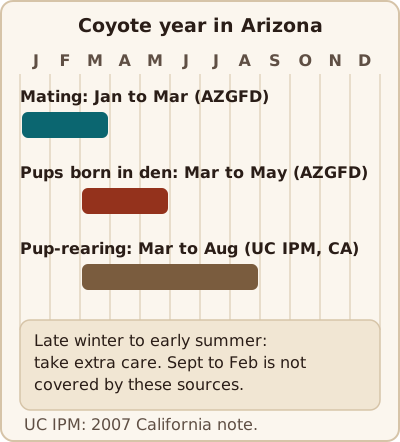
When is breeding and pup season?
AZGFD gives January to March for mating and March to May for pups. Here is what extension sources say, with their region, for comparison.
| Source | Region | Breeding | Pups born |
|---|---|---|---|
| Arizona Game and Fish Department (current) | Arizona | January to March | March to May, 4 to 7 pups |
| University of Nebraska-Lincoln wildlife damage center | General (U.S.) | January to March; gestation about 63 days | “In the spring” |
| University of California IPM (2007) | California | Late January and February | March and April |
| University of Florida IFAS | Florida | Not stated | March through May |
Taken together, they point to winter breeding and spring births. That is a reasonable basis for treating late winter through early summer as the period to take extra care, and AZGFD’s Arizona dates fit that pattern. For current local advice, check azgfd.com or call the 24-hour AZGFD Communications Center, 623-236-7201, if a coyote is acting aggressively toward people (confirm the number before relying on it).
The University of Nebraska-Lincoln center also says coyotes become sexually mature at about 12 months, breed once a year, and that daytime activity is more likely during the mating and breeding seasons, in cool weather and when human activity is low. A coyote seen in daylight in winter may therefore simply fit the breeding season, as it also fits other explanations. We do not treat a daytime sighting as a sign of illness.
Litter size and family life
AZGFD says four to seven pups. Other sources agree closely: University of California IPM says normally four to seven and the University of Nebraska-Lincoln center says usually five to seven with a reported maximum of 13. University of Florida IFAS says litters of 5 to 7. These are reports from different regions and studies, and none is a count for any specific den.
On what happens next, from the University of Nebraska-Lincoln center:
- Pups start leaving the den by about 3 weeks of age and are usually weaned by about 6 weeks.
- Both adult parents bring food to the young for several weeks, and other adults in the group may help.
- By about two months pups follow adults to hunt or feed on carrion.
- Adults and pups usually stay together until fall or early winter, when pups become independent. Pups may travel 50 miles or more from their birthplace.
University of California IPM agrees on the three-week emergence and says parents and offspring remain together for about six months. University of Florida IFAS says both parents contribute to raising offspring, pups stay with the family group for the first year and then usually disperse, and that coyotes do not typically form packs as wolves do.
For a neighborhood, this means a group of coyotes seen together in summer may be a family rather than a hunting pack.
Dens
The University of Nebraska-Lincoln center says dens are mainly used for raising young; coyotes often dig out or enlarge burrows made by smaller animals. Dens range from 3 to 50 feet long and may have several entrances. Typical sites are protected and concealed: steep banks, rock crevices, sinkholes and underbrush, usually within a mile of water. It also says pups are often moved from the den to larger sites such as dense brush or sinkholes near water.
Noise near a den is common in spring too; our guide to coyote howls, yips and what they mean explains the sounds.
University of California IPM says that before giving birth, adults excavate one or more dens in the soil, or use hollow logs, rock piles or culverts. University of Florida IFAS says coyotes will den and raise pups in parks, vacant lots, golf courses and other areas that provide some security in otherwise developed landscapes. That is a Florida statement about urban areas, but it is consistent with AZGFD saying coyotes appear at golf courses, parks and preserves.
AZGFD recommends trimming plants and bushes around the house to prevent hiding or resting places and removing food sources. Neither is an instruction to disturb a den.
What to do if you suspect a den near your home
The AZGFD page we captured says pups are born in a den but gives no den-specific guidance, so this section is cautious and mostly points to the agencies.
- Keep your distance and keep children and pets away from the area. Do not approach, photograph from close range, feed, or try to look into a den.
- Do not haze a coyote that seems to be guarding young. Our editorial rule: keep your distance and call. The hazing methods AZGFD describes are for a coyote that approaches you in the open, not for an animal defending young.
- Call AZGFD or local animal control and describe where the den is and who uses the area. Our reporting page explains how to report.
- Do not trap, poison, relocate or shoot. AZGFD does not relocate or remove coyotes unless there is a public-safety concern, and says coyotes can only be captured or killed by someone with a proper license from the department, or in defense of yourself or another person, and to check local ordinances about firearms and traps. Confirm with AZGFD.
- Take away what feeds them: pet food, unsecured garbage, fallen fruit and water sources a neighbor may be leaving out.
Pets in pup season
For the rest of the year, see coyote seasons and pet safety.
University of Florida IFAS says coyotes are known to prey on cats and small dogs left unattended outdoors, especially during spring when raising pups, and that small dogs should be kept on short leads where coyotes are known to occur and cats should never be allowed to roam freely. AZGFD’s guidance is consistent: supervise small pets at all times outside, keep small pets indoors or in a roofed enclosure, always leash dogs, keep cats indoors or in a secure outdoor enclosure, and if you see a coyote on a walk, gather your dog in your arms or keep it close and move toward an area of human activity.
More on this in keeping small dogs safe from coyotes, outdoor cats and coyotes in Arizona and walking your dog where coyotes live. The full set is in the pet and child safety hub.
The sources we opened do not say that people are more at risk in pup season, and we do not say so. AZGFD ties the risk to people to coyotes that have become comfortable with humans through feeding or indifference.
Emergency numbers and what AZGFD will and will not do
AZGFD (current Living with Coyotes page and April 2023 news release, both accessed 2026-11-14) says that if a coyote attacks a person, you should report it to the department or call 911, and that anyone who is bitten should seek medical care immediately. Its 24-hour Communications Center for wildlife acting aggressively toward people is 623-236-7201 (confirm before relying on it). If a coyote is approaching or has bitten someone, call 911. For a pet that has been attacked, call your vet first.
AZGFD does not respond to calls to relocate or remove coyotes unless there is a public-safety concern; for removal on private property it points residents to a licensed wildlife-removal business. The news release says predators that attacked people or show predatory or aggressive behavior toward people are removed lethally only as a last resort and cannot be relocated for public-safety reasons, and that removal does not help if attractants remain. Pima Animal Care Center dispatch is 520-724-5900 ext. 4 (pima.gov; confirm before relying on it).
Feeding wildlife (except birds and tree squirrels) is unlawful in Maricopa, Pinal and Pima counties under A.R.S. 13-2927, according to the AZGFD news release; some cities and counties have their own ordinances. Checked on 2026-11-14; confirm with AZGFD and your local animal control.
If a pet or person is bitten or scratched
Contact with a wild animal can be a rabies exposure. The CDC advises washing bites or scratches immediately with soap and water and urgently seeking medical attention. AZGFD says Arizona Department of Health Services records show an extremely low occurrence of rabid coyotes in the state, but coyotes can be rabid. Call your doctor or vet and local animal control after any bite, scratch or contact. For a pet, vet attention comes first.
What we could not source
- AZGFD guidance specific to dens or denning coyotes in neighborhoods (the current page gives timing and litter size only).
- Whether coyote behavior toward people changes in pup season in Arizona.
- Urban den site data for Pima County or Green Valley.
Related guides
Frequently asked questions
When is coyote pup season in Arizona?
AZGFD says coyotes mate from January to March and have their pups in a den from March to May. University of California IPM says pups are born in March and April in California, and the University of Nebraska-Lincoln center says breeding runs January to March, so the sources agree. Treat spring as the pup season and check azgfd.com for local timing.
How many pups do coyotes have?
AZGFD says four to seven pups in a den (its 2015 brochure said two to 12, average six). University of California IPM says litter size is normally four to seven pups, and the University of Nebraska-Lincoln center says usually five to seven, with a reported maximum of 13. Sources differ by region and study, so use these as ranges, not predictions for any particular den near you.
Are coyotes more dangerous when they have pups?
The sources we opened do not say that coyotes attack people more in pup season. University of Florida IFAS says coyotes are known to prey on cats and small dogs left unattended outdoors, especially in spring when raising pups. Our precaution is to keep your distance from a den or any coyote that seems to be guarding young, and to call AZGFD or animal control.
What should I do if I find a coyote den?
Keep away, keep pets and children away, and call AZGFD or local animal control. Do not approach, haze, feed, trap or move pups or adults. AZGFD says removing coyotes from one area generally leads to others moving in and breeding faster, and that capturing or killing coyotes needs a license from the department except in defense of people. Confirm rules with AZGFD.
Where do coyotes put their dens?
The University of Nebraska-Lincoln center says dens are mainly used for raising young, often dug out or enlarged burrows made by smaller animals, 3 to 50 feet long with several entrances, in protected, concealed sites such as steep banks, rock crevices, sinkholes and underbrush, usually within a mile of water. University of California IPM adds hollow logs, rock piles and culverts. Urban dens are not described in Arizona sources we opened.
Do pups stay with their parents?
University of Nebraska-Lincoln says both adults bring food to the young, pups leave the den by about three weeks, are usually weaned by about six weeks, and stay with adults until fall or early winter when they become independent. University of California IPM says parents and offspring stay together about six months. Seeing several coyotes together in summer may therefore be a family.
Should I keep my small dog or cat inside during pup season?
AZGFD advises keeping cats indoors or in a secure enclosure, supervising small pets at all times outside, and keeping dogs on a leash or in an enclosed area. University of Florida IFAS says small dogs should be kept on short leads where coyotes occur and cats should never roam freely, particularly in spring. If a pet has any contact with a wild animal, call your vet and animal control.
Sources
- Arizona Game and Fish Department, Living with Coyotes (azgfd.com, accessed 2026-11-14) (azgfd.com)
- Arizona Game and Fish Department, TIPS to avoid conflicts with coyotes (news release, April 7, 2023; accessed 2026-11-14) (azgfd.com)
- Arizona Game and Fish Department, Living with Coyotes brochure (2015; older document, cited only where noted) (s3.amazonaws.com)
- University of Nebraska-Lincoln, Internet Center for Wildlife Damage Management: Coyote Biology (icwdm.org)
- University of California IPM, Coyote (Pest Notes, 2007) (ipm.ucanr.edu)
- University of Florida IFAS Extension, Commonly Asked Questions About Coyotes in Florida (ask.ifas.ufl.edu)
- CDC, About Rabies (cdc.gov)
Related guides
- Coyote Information for Arizona Homeowners
What agencies and extension services say about urban coyotes in Arizona: what they are, why they come near homes, and rabies and distemper.
- Coyote Behavior in Arizona Neighborhoods
What AZGFD and extension sources say about normal coyote behavior, when it becomes a concern, and what feeding and indifference cause.
- Coyote vs Dog, Fox and Bobcat: How to Tell Them Apart
What extension and wildlife agencies say about telling coyotes from dogs and bobcats by tracks and body, and the limits of what we could source for foxes.
- Coyote Tracks, Scat and Other Signs
What university extension sources say about coyote track size and shape, why scat identification is hard, and how to stay safe when checking for signs.
- Coyote Sounds: Howls, Yips and What They Mean
Coyote howls, yips and barks in Arizona: what the sounds are, when you hear them, and what the agencies say about hearing coyotes near your home.
- What Urban Coyotes Eat
What coyotes eat in Arizona, from rodents and fruit to garbage, pet food and small pets, and what that means for your yard.