Walking Your Dog Where Coyotes Live
By CoyoteBytes Editorial TeamChecked by CoyoteBytes Editorial TeamReview date First published Filed under Pets & Children
AZGFD's advice for dog walkers is brief: always leash dogs, allow off-leash time only in enclosed areas with immediate recall, and if you see a coyote, let it know you are there, gather your dog in your arms or keep it as close as possible, use the described deterrents, and move toward an area of human activity. This page sets out those steps and their limits.
Part of our guide: Protect Pets and Children from Coyotes in Arizona
Dog walks are where most people actually meet a coyote, and the moment is easier to handle with a plan. This guide is part of our pet and child safety hub and follows the Arizona Game and Fish Department (AZGFD) closely.
This is general information, not veterinary, medical or legal advice. For an injured or aggressive animal, a bite, a pet attack or a suspected rabies exposure, call your doctor, your vet, local animal control, or the Arizona Game and Fish Department (AZGFD).
Reviewed by the editorial desk against the cited sources. The desk holds no wildlife-biology, veterinary or medical credential; see our editorial policy. Walking advice from the agencies is short, so this page is short on invented detail and long on what they actually say.
Which dogs are most at risk on a walk?
AZGFD says pets most likely to be endangered by coyotes are typically off-leash or smaller than 25 pounds. It adds that coyotes have taken cats and small dogs in the vicinity of their owners and occasionally right off the leash, and that coyotes have been reported to attack larger dogs when they are in groups, or after one or two have lured a dog away from its owner.
So there are three separate risks on a walk: the dog is small, the dog is off leash, or the dog is lured or ganged up on. Of the three, only the first can’t be changed. For small dogs in particular, see keeping small dogs safe from coyotes.
AZGFD also says children under 5 should be supervised wherever wildlife may be a concern, “with domestic dogs that could attract or fight with coyotes.” A walk with children and a dog together deserves extra attention; see the hub for child-safety guidance.
Before you leave home
Leash up
AZGFD says to keep pets indoors or on a leash and to allow off-leash only in enclosed areas. University of Florida IFAS says small dogs should be kept on short leads where coyotes are known to occur. A short lead keeps your dog near, which is the closest match to AZGFD’s instruction to keep a dog “as close to you as possible.” We did not find an agency source that rates leash types, so we do not.
Be honest about recall
AZGFD says a dog that is off leash must have an immediate recall response. AZGFD’s guidance is that dogs should always be leashed and that off-leash time belongs in enclosed areas such as a fenced yard or dog park, not on trails where coyotes travel. If your dog sometimes ignores you, it should not be off leash where wild animals may appear.
Think about the time and place
University of California IPM says coyotes are most active after dusk and before daylight. The University of Nebraska-Lincoln wildlife damage center says coyotes are most active at night and in early morning in hot summer weather, and that daytime activity is more likely during mating and breeding seasons, in cool weather and when human activity is low. These are not Arizona-specific, and AZGFD gives no curfew, but advises supervising small pets at night and dawn. Reasonable inference: dawn, dusk and night walks through washes, vacant lots and golf course edges carry more chance of an encounter. See what normal coyote behavior looks like and coyote breeding and pup season.
Carry a light and a phone
This is our practical suggestion and not from a source. You can call animal control or AZGFD from a phone, and a light lets you see what is ahead. AZGFD lists outdoor lighting as a yard measure but says nothing specific about walking lights.
If you see a coyote on your walk
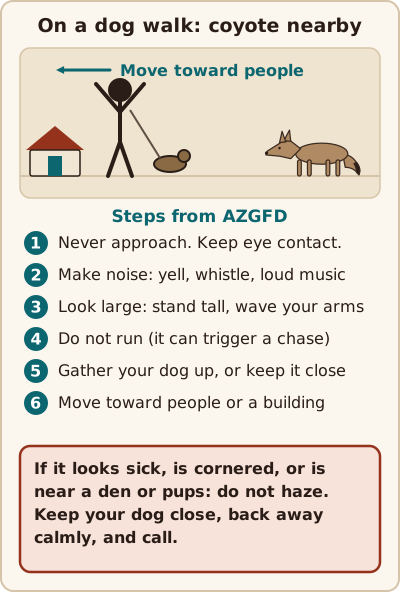
AZGFD’s guidance for walking with a dog: let the coyote know you are there. Gather your dog in your arms or keep it as close to you as possible, while also using the deterrents the department describes. Move toward an area of human activity.
The deterrents it lists:
- Never approach a coyote.
- Keep eye contact with the animal.
- Make noise. Yell, use whistles, play loud music, or bang pots and pans. A homemade “coyote shaker,” a can filled with washers, pebbles or pennies wrapped in foil, is described as combining reflected light, noise and an aggressive gesture.
- Look large. Stand tall and wave your arms. AZGFD lists further deterrents; this guide focuses on noise and distance.
- Do not run. Running can stimulate a coyote’s chase instinct.
- Pick up small pets and, if children are with you, protect them so they do not panic and run.
- Move toward an area with other people or a building.
We list only noise, visual deterrents, large posture and moving away. We do not repeat any method involving throwing objects or chemicals, and we do not recommend any contact with the coyote.
When not to haze
Our editorial rule, which is not a quote from a source: if the coyote looks sick, is cornered, is near a den or seems to be guarding pups, do not try to haze it. Keep your distance, keep your dog close, back away calmly and call AZGFD or animal control from a safe place. University of California IPM adds that hazing provides only temporary effectiveness, if any, because coyotes quickly adapt to sounds and lights without a real threat, which is another reason to use hazing to leave the area, not to win a standoff.
After the encounter
- Leave the area by a route that does not pass the coyote.
- If the coyote showed no fear, followed you, or approached your dog or a person, report it. Our reporting page explains who to call, and Who to Call lists agencies.
- If anything touched your dog, see a vet. Any contact between a pet and a wild animal means calling your vet and local animal control, and the CDC advises keeping pets up to date on rabies vaccines.
- If a person was bitten or scratched, wash the wound immediately with soap and water and urgently seek medical attention, per the CDC.
AZGFD says Arizona Department of Health Services records show an extremely low occurrence of rabid coyotes in the state, while noting coyotes can be rabid. The CDC page we opened does not describe signs of rabies in animals, so we do not list any; if an animal seems ill or odd, keep your distance and call.
What we could not source
- Any agency evaluation of leash types, harnesses, lights, whistles or commercial deterrents.
- Arizona-specific times of day or seasons that are riskiest for walks.
- Trail-specific guidance from Pima County or the Pima County Natural Resources, Parks and Recreation department (its older wildlife page directs readers to pima.gov and does not give pet-walking tips).
- How to handle encounters with several coyotes at once. AZGFD notes that groups have attacked larger dogs, but gives no separate steps; leaving the area and calling is the safe reading.
A note on feeding and the law
Do not leave food for coyotes or other wildlife along a walking route. AZGFD says never to feed coyotes, and its April 2023 release says feeding wildlife (except birds and tree squirrels) is unlawful in Maricopa, Pinal and Pima counties under A.R.S. 13-2927. Checked on 2026-11-14; confirm with AZGFD.
Emergency numbers and what AZGFD will and will not do
AZGFD (current Living with Coyotes page and April 2023 news release, both accessed 2026-11-14) says that if a coyote attacks a person, you should report it to the department or call 911, and that anyone who is bitten should seek medical care immediately. Its 24-hour Communications Center for wildlife acting aggressively toward people is 623-236-7201 (confirm before relying on it). If a coyote is approaching or has bitten someone, call 911. For a pet that has been attacked, call your vet first.
AZGFD does not respond to calls to relocate or remove coyotes unless there is a public-safety concern; for removal on private property it points residents to a licensed wildlife-removal business. The news release says predators that attacked people or show predatory or aggressive behavior toward people are removed lethally only as a last resort and cannot be relocated for public-safety reasons, and that removal does not help if attractants remain. Pima Animal Care Center dispatch is 520-724-5900 ext. 4 (pima.gov; confirm before relying on it).
Feeding wildlife (except birds and tree squirrels) is unlawful in Maricopa, Pinal and Pima counties under A.R.S. 13-2927, according to the AZGFD news release; some cities and counties have their own ordinances. Checked on 2026-11-14; confirm with AZGFD and your local animal control.
AZGFD also says bold coyotes have attacked small dogs on retractable leashes, so keep the line short and your dog close.
Related guides
Frequently asked questions
Should I walk my dog on a leash where coyotes live?
Yes. AZGFD says pets most likely to be endangered by coyotes are typically off-leash or smaller than 25 pounds, and advises allowing pets off-leash only in enclosed areas. University of Florida IFAS says small dogs should be on short leads where coyotes occur. A leash does not guarantee safety, since AZGFD says coyotes have occasionally taken small dogs right off the leash.
What do I do if I see a coyote while walking my dog?
AZGFD says to let the coyote know you are there. Gather your dog in your arms or keep it as close as possible, use noise and large, aggressive gestures, and move toward an area of human activity. Never approach the coyote, and do not run, which can stimulate its chase instinct. If the coyote seems sick, cornered or does not retreat, leave and call AZGFD or animal control.
Can I let my dog off leash if it has good recall?
AZGFD says to allow pets off-leash only in enclosed areas, and that an off-leash dog must have immediate recall response to prevent conflicts with coyotes and other wildlife. The department also says coyotes have lured dogs away from their owners and attacked larger dogs in groups, so a recall that works at home may not be enough in coyote country. The safest choice is a leash.
Is it safer to walk at certain times of day?
University of California IPM says coyotes are most active after dusk and before daylight, and the University of Nebraska-Lincoln wildlife damage center says daytime activity is more likely during the breeding season, in cool weather and when human activity is low. Neither is an Arizona statement. AZGFD gives no walking curfew, so we do not either.
What if the coyote approaches my dog or stays close?
Keep your dog close or pick it up, stay calm, make noise and look large, and move toward people or a building, as AZGFD describes. Do not turn your back and run, and do not let the dog chase or approach the coyote. A coyote that keeps approaching, shows no fear or looks unwell should be reported. Keep your distance and call AZGFD or local animal control.
What if my dog is bitten on a walk?
Go straight to a vet; veterinary attention comes first after a pet attack. Any contact between a pet and a wild animal means calling your vet and local animal control. If you were bitten or scratched, wash the wound immediately with soap and water and urgently seek medical care, as the CDC advises after a possible rabies exposure. Then report the incident to AZGFD or animal control.
Can I carry something to scare coyotes away on walks?
AZGFD describes noise-makers such as whistles, and a homemade shaker can wrapped in foil and filled with washers, pebbles or pennies, whose rattle, reflected light and shaking gesture serve as deterrents. We did not find agency advice on commercial products and we do not recommend any. We also do not suggest carrying anything to throw or spray at wildlife; only the methods the agency describes.
Sources
- Arizona Game and Fish Department, Living with Coyotes (azgfd.com, accessed 2026-11-14) (azgfd.com)
- Arizona Game and Fish Department, TIPS to avoid conflicts with coyotes (news release, April 7, 2023; accessed 2026-11-14) (azgfd.com)
- Arizona Game and Fish Department, Living with Coyotes brochure (2015; older document, cited only where noted) (s3.amazonaws.com)
- University of Florida IFAS Extension, Commonly Asked Questions About Coyotes in Florida (ask.ifas.ufl.edu)
- University of California IPM, Coyote (Pest Notes, 2007) (ipm.ucanr.edu)
- University of Nebraska-Lincoln, Internet Center for Wildlife Damage Management: Coyote Biology (icwdm.org)
- CDC, About Rabies (cdc.gov)
Related guides
- Protect Pets and Children from Coyotes in Arizona
What University of Arizona extension, UC IPM, Pima County and the CDC say about keeping pets and children safe from coyotes in Arizona neighborhoods.
- Coyote Seasons and Pet Safety: What the Sources Say
Coyote activity through the year and what to do for your pets each season, from AZGFD mating and pup dates to dawn, dusk and denning advice.
- Keeping Small Dogs Safe from Coyotes
What AZGFD and extension sources say about protecting small dogs from coyotes, from supervision and leashes to yards, enclosures and encounters.
- Outdoor Cats and Coyotes in Arizona
What AZGFD and extension sources say about coyotes and outdoor cats, why they advise indoor living or a secure enclosure, and what to do if a cat is hurt.
- Children and Coyotes: A Safety Guide
How to keep children safe around coyotes in Arizona, from AZGFD, UC and CDC guidance: supervision, yards, if a coyote approaches, and who to call.
- Coyotes and Backyard Poultry or Livestock
What University of Arizona Extension, UC IPM, USDA and AZGFD say about protecting poultry and livestock from coyotes, and what the rules say.