Coyote Information for Arizona Homeowners
By CoyoteBytes Editorial TeamChecked by CoyoteBytes Editorial TeamReview date First published Filed under Coyote Information
Coyotes are common visitors to Tucson-area neighborhoods, and most sightings are not dangerous. Agencies say problems usually start when animals link people with food, so securing garbage, pet food and bird seed matters most. Treat any coyote that seems sick, unafraid of people or disoriented as a call, not a project: keep distance and phone AZGFD or Pima Animal Care Center.
This is general information, not veterinary, medical or legal advice. For an injured or aggressive animal, a bite, a pet attack or a suspected rabies exposure, call your doctor, your vet, local animal control, or the Arizona Game and Fish Department (AZGFD).
Reviewed by the editorial desk against the cited sources. The desk holds no wildlife-biology, veterinary or medical credential; see our editorial policy.
Coyotes are a regular part of life around Tucson and Green Valley, and most sightings do not lead to a problem. This hub explains what the agencies and extension services say about coyotes in neighborhoods, then points to the guides for yards, pets, encounters and who to call. For the practical home steps, start with the yard and home guide; for a sighting right now, go to Safe responses to a nearby coyote.
What a coyote is
UC IPM’s coyote Pest Note, published by the University of California, describes the coyote as resembling a small German shepherd dog, but with a longer, narrower snout and a bushy black-tipped tail. It gives typical weights of about 20 to 35 pounds for males and 18 to 25 pounds for females, and coloring that ranges from rust-brown to gray. These figures come from a California publication last updated in March 2007; we did not find Arizona-specific measurements on the agency pages we could open.
Are coyotes common here?
Pima County describes coyotes, bobcats and javelina as common visitors to neighborhoods in the Tucson area. Seeing one, including near a home, is not by itself a sign of danger. What matters is behavior and what is drawing the animal in.
Why they come near homes
University of Arizona Cooperative Extension says attacks on people usually occur when animals associate people with food, and that negative encounters with wildlife are usually set in motion by people. Coyotes, javelina, bobcats and elk that are attracted to one home often visit the neighboring lots, according to the same publication. The most useful steps are therefore the ones that remove food and water: secure garbage, feed pets indoors, keep bird seed off the ground, and do not feed wildlife on purpose. Details are in the yard and home guide.
Pups and the breeding season
UC IPM reports that coyotes breed annually, with pups born in March and April and litters usually of 4 to 7 pups (California figures). A coyote protecting a den or pups can behave differently from one passing through, so keep your distance and do not try to haze it. See Our encounter response steps.
Coyote behavior to take seriously
AZGFD’s August 2025 bulletin on canine distemper says infected coyotes and foxes may act unusually, such as showing little fear of people, stumbling, having seizures, or discharging from the eyes and nose. Distemper cannot infect humans, but the bulletin says it cannot be distinguished from rabies based on clinical symptoms, so sick animals should be treated as potentially rabid. Do not approach or touch a sick-looking animal; call. The bulletin asked residents to report sick or dead animals to AZGFD, and gave 623-236-7201 as its 24-hour hotline.
Rabies
The CDC says rabies is a fatal but preventable viral disease and that it spreads primarily through bites or scratches from an infected animal. The animals it names as most often found with rabies in the United States are bats, raccoons, skunks and foxes. After any bite or scratch, wash the wound and get medical care urgently. Pima County adds that wild animals not afraid of people are abnormal. Full steps are on the encounter page.
What coyotes can and cannot do to a pet
UC IPM says coyotes attack pets and that cats and dogs allowed to run free are easy prey. The University of Arizona says pets left to roam may end up as a meal for coyotes and other predators. The pet and child safety guide lists what the sources recommend.
Rules and agencies
Feeding wildlife is covered by A.R.S. 13-2927 in Maricopa, Pinal and Pima counties (checked on 2026-11-14). Confirm with AZGFD. For phone numbers see Who to Call About Coyotes in Pima County and Arizona.
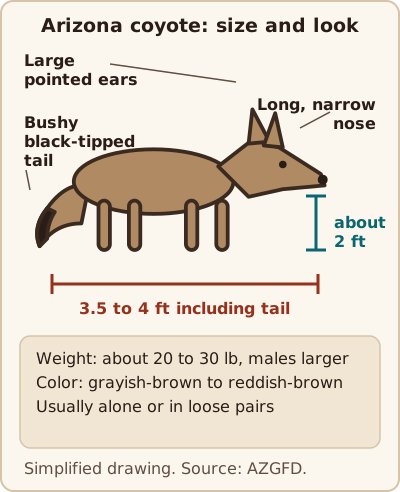
Size and appearance in Arizona
AZGFD describes the coyote as a medium-sized, doglike canid, grayish-brown to reddish-brown, with large pointed ears, a long narrow nose and a bushy black-tipped tail. It gives a length of about 3.5 to 4 feet including the tail and about 2 feet at the shoulder, and says Arizona coyotes weigh roughly 20 to 30 pounds, with males larger (AZGFD, Living with Coyotes, accessed 2026-11-14). That Arizona-specific figure is the better guide for local animals than the California weights quoted above.
What coyotes eat
AZGFD calls coyotes opportunistic omnivores. Their natural diet includes rabbits, rodents, birds, snakes, insects, fish, fruit, carrion and livestock, and in cities they also take advantage of garbage and ornamental fruit (AZGFD). That is why household food sources, and the rodents and rabbits they attract, matter more than the coyote itself.
Habits and sounds
AZGFD says coyotes are common in rural and suburban Arizona, are vocal (howls, yelps and barks), and usually travel and hunt alone or in loose pairs (AZGFD). For what those calls mean and when you are most likely to hear them, see our guide to coyote howls, yips and other sounds. Typically timid, they run if challenged. AZGFD adds that risk rises when coyotes are fed or met with indifference, and that human-fed coyotes have on rare occasions bitten people.
Mating season and pups
According to AZGFD, coyotes mate from January to March, and 4 to 7 pups are born in a den between March and May (AZGFD). A coyote near a den may act protectively, so keep your distance, keep dogs leashed and do not haze it; if it is near people, call the agencies.
What attracts coyotes to a home
AZGFD groups attractants into three kinds: food (rabbits, birds, rodents, livestock, pet food, unattended pets, garbage and fallen fruit), water (pet bowls, fountains and pools) and shelter (shrubs, storm drains and the space under sheds and porches) (AZGFD). Removing even one of the three can make a yard less appealing. The step-by-step lists are in the yard and home guide.
How often do coyotes attack people?
AZGFD’s April 2023 release counted 24 coyote attacks on people in the Phoenix metro area over the previous 26 years, including two attacks on toddlers in Scottsdale that caused minor injuries (AZGFD tips release). It explains that feeding wildlife makes coyotes, javelina, bobcats, bears and mountain lions lose their fear of people, which leads to conflict. These are metro Phoenix figures, not Pima County figures.
Will AZGFD remove or relocate a coyote?
Not for a nuisance. AZGFD says it does not respond to calls to relocate or remove coyotes unless there is a public-safety concern, and suggests a licensed wildlife-removal business for relocation (AZGFD). The April 2023 release adds that coyotes that attacked people or show predatory or aggressive behavior toward people are lethally removed only as a last resort, cannot be relocated for public-safety reasons, and that removal does not help if attractants remain. If a coyote is approaching or has bitten a person, call 911 and seek medical care immediately for any bite; AZGFD’s 24-hour Communications Center for wildlife acting aggressively toward people is 623-236-7201 (AZGFD tips release).
Pages we have not yet published are not linked here. As they go live, this hub will link each page on coyote behavior, tracks and signs, and identification.
The owner supplies rights-held photos where a photo belongs; this site does not use AI-generated wildlife images.
All Coyote Information guides
- Coyote Behavior in Arizona Neighborhoods
What AZGFD and extension sources say about normal coyote behavior, when it becomes a concern, and what feeding and indifference cause.
- Coyote Breeding and Pup Season in Arizona
What AZGFD and extension sources say about coyote breeding, litter size, dens and pups, why spring needs extra pet care, and what to do near a den.
- Coyote Tracks, Scat and Other Signs
What university extension sources say about coyote track size and shape, why scat identification is hard, and how to stay safe when checking for signs.
- Coyote vs Dog, Fox and Bobcat: How to Tell Them Apart
What extension and wildlife agencies say about telling coyotes from dogs and bobcats by tracks and body, and the limits of what we could source for foxes.
Frequently asked questions
Are coyotes common in Tucson and Green Valley neighborhoods?
Pima County describes coyotes, bobcats and javelina as common visitors to neighborhoods in the Tucson area. A sighting is not by itself a reason to worry. What the agencies stress is that food, water and shelter near homes draw wildlife in, so removing those matters more than the sighting.
Why do coyotes come near houses?
University of Arizona Cooperative Extension says animals drawn to one home often visit neighboring lots, and that attacks on people usually occur when animals associate people with food. Pet food, garbage, spilled bird seed and deliberate feeding are the usual causes. Securing those sources is the first step for homeowners.
How can I tell if a coyote is sick?
AZGFD's August 2025 bulletin says infected coyotes and foxes may show little fear of people, stumble, have seizures, or discharge from the eyes and nose. Distemper cannot be told from rabies by symptoms, so treat the animal as potentially rabid. Keep your distance, keep pets away, and report it to AZGFD or Pima Animal Care Center.
When are coyote pups born?
UC IPM, a University of California program, reports that coyotes breed annually, with pups born in March and April and litters usually of 4 to 7. These are California figures. A coyote guarding a den or pups should be left alone: keep your distance and call the agencies if it is near people.
Can a coyote give me rabies?
The CDC says rabies spreads primarily through bites or scratches from an infected animal and names bats, raccoons, skunks and foxes as the animals most often found with rabies. After any bite or scratch from a wild animal, wash the wound with soap and water and get medical care urgently, and tell your doctor the animal involved.
Do coyotes attack pets?
UC IPM lists attacks on pets among coyote damage and says cats and dogs allowed to run free are easy prey. University of Arizona Cooperative Extension says to supervise pets outdoors rather than let them roam. If your pet has contact with a wild animal, call your vet and Pima Animal Care Center.
Sources
- UC IPM Pest Notes: Coyote (UC ANR Publication 74135, updated March 2007) (ipm.ucanr.edu)
- Pima County: Living with Urban Wildlife (page marked not maintained) (oldcms.pima.gov)
- University of Arizona Cooperative Extension: Preventing Dangerous Interactions with Wildlife (AZ1481d) (extension.arizona.edu)
- University of Arizona Cooperative Extension: Potential Wildlife Conflicts (AZ1481c) (extension.arizona.edu)
- AZGFD bulletin: AZGFD urges vigilance during canine distemper outbreak (12 Aug 2025) (content.govdelivery.com)
- CDC: About Rabies (cdc.gov)
- CDC: Rabies Prevention and Control (cdc.gov)
- Arizona Revised Statutes 13-2927 (unlawful feeding of wildlife) (azleg.gov)
- Arizona Game and Fish Department: Living with Coyotes (accessed 2026-11-14) (azgfd.com)
- Arizona Game and Fish Department: TIPS to avoid conflicts with coyotes (7 Apr 2023; accessed 2026-11-14) (azgfd.com)
Related guides
- Coyote Behavior in Arizona Neighborhoods
What AZGFD and extension sources say about normal coyote behavior, when it becomes a concern, and what feeding and indifference cause.
- Coyote Breeding and Pup Season in Arizona
What AZGFD and extension sources say about coyote breeding, litter size, dens and pups, why spring needs extra pet care, and what to do near a den.
- Coyote vs Dog, Fox and Bobcat: How to Tell Them Apart
What extension and wildlife agencies say about telling coyotes from dogs and bobcats by tracks and body, and the limits of what we could source for foxes.
- Coyote Tracks, Scat and Other Signs
What university extension sources say about coyote track size and shape, why scat identification is hard, and how to stay safe when checking for signs.
- Coyote Sounds: Howls, Yips and What They Mean
Coyote howls, yips and barks in Arizona: what the sounds are, when you hear them, and what the agencies say about hearing coyotes near your home.
- What Urban Coyotes Eat
What coyotes eat in Arizona, from rodents and fruit to garbage, pet food and small pets, and what that means for your yard.