Coyote Fencing for Arizona Yards
By CoyoteBytes Editorial TeamChecked by CoyoteBytes Editorial TeamReview date First published Filed under Yard & Home
The Arizona Game and Fish Department (AZGFD) says a 6-foot fence is not reliable protection because coyotes are skilled jumpers, and advises keeping small pets indoors or in a roofed enclosure. UC extension sources say 8-foot fences are recommended where possible and that no fence is guaranteed. Fencing works best alongside removing food, water and cover.
Part of our guide: Manage and Protect Arizona Homes from Urban Coyotes
This is general information, not veterinary, medical or legal advice. For an injured or aggressive animal, a bite, a pet attack or a suspected rabies exposure, call your doctor, your vet, local animal control, or the Arizona Game and Fish Department (AZGFD).
Reviewed by the editorial desk against the cited sources. The desk holds no wildlife-biology, veterinary or medical credential.
Fencing is one part of our yard and home coyote management guide. It helps, but it never replaces removing food, water and hiding places: see the coyote-proof yard checklist and removing food and water attractants. This page collects what the agencies say about fence height, bottoms, tops and gates, and flags where Arizona residents should check local rules.
The short answer from the agencies
AZGFD says a 6-foot fence is not reliable protection, because coyotes are skilled jumpers, and that small pets belong indoors or in a roofed enclosure, supervised at night and dawn, and always leashed outside (some bold coyotes have attacked small dogs on retractable leashes). So treat a fence as one layer, not the answer.
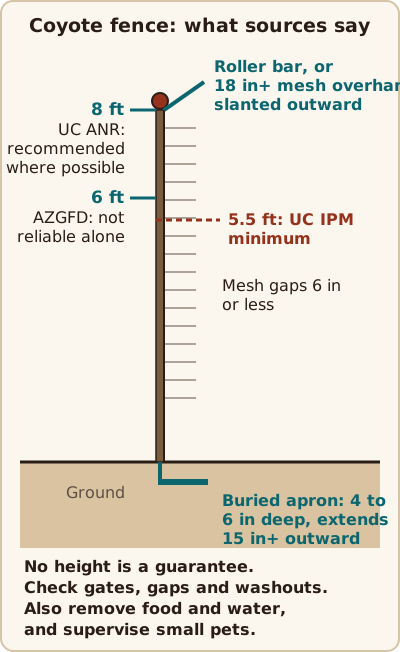
UC ANR’s guidance for urban residents says coyotes are excellent jumpers that can clear 6-foot walls, and recommends 8-foot fences where possible, with a roller bar on top to discourage climbing. UC IPM, in its Pest Notes on coyotes, adds that it is expensive and difficult to build a completely coyote-proof fence.
We cite two California sources (UC ANR and UC IPM) alongside AZGFD because Arizona agencies publish little fence detail in the pages we could open. UC IPM’s 2007 note is a California publication, so use it as general design guidance, not Arizona regulation.
How coyotes get past fences
UC IPM says coyotes have the physical ability to go under, through or over many types of fences. It says they generally prefer to dig under fences or go through gaps at gates or washouts, but some coyotes jump or climb, particularly at corners or where cross-braces provide a foothold.
That gives you four weak points to check:
- Height, especially on sloping ground, where UC IPM says the fence should be built higher.
- The top edge, where a foothold lets a coyote climb or pull itself over.
- The bottom edge, where digging happens.
- Gates, gaps and washouts.
Design details from the agencies
Height
- AZGFD: 6 feet is not reliable on its own.
- UC ANR: 8 feet recommended where possible.
- UC IPM: a minimum of 5.5 feet, built higher on sloping terrain.
Pick the higher figure if you can. Local height limits for walls and fences vary by city and county, and we have no Arizona page that lists them, so check with your local planning office or homeowners’ association before building.
The bottom
UC IPM gives a design: attach a galvanized wire-mesh apron securely to the bottom of the fence, 4 to 6 inches below the soil, extending outward at least 15 inches. UC IPM also says net wire mesh should be no larger than 6 inches between stays.
The top
UC ANR says a roller bar can discourage climbing. UC IPM says a wire-mesh overhang of at least 18 inches slanted outward, or roller-type devices attached to the top, can add protection against coyotes scaling a fence.
We do not advise barbed or electrified fencing for a residential yard without checking the law and the risk to people, children and pets. Barbed or electrified fences may be restricted by local rules or homeowners’ association covenants. UC IPM specifically says electrical fencing may be inappropriate or illegal in residential or suburban areas.
Gates and low spots
Keep gates tight to the ground and latched. UC IPM says to look at where and how coyotes got through a fence, because quality fencing can leave evidence of where they penetrated, and this helps you choose other measures. Walk the fence line after heavy rain, since washouts open gaps.
Crawl spaces and structures
UC IPM says to close off crawl spaces under mobile homes, porches, decks and garden sheds, because coyotes can use these areas to rest and to rear their young.
Fencing for pets, poultry and small animals
AZGFD says small pets should be supervised or kept in a secure enclosure with a roof. UC ANR says backyard poultry, livestock and other small outdoor animals should be enclosed with secure fencing and a roof, protecting them from all angles because coyotes can also dig. UC IPM says to confine livestock and poultry from dusk to dawn. Cats are safest indoors or in a secure outdoor enclosure, as AZGFD says.
If your dog’s kennel run is the weak point, give it the same scrutiny as the yard fence: top, bottom and gate.
Limits of fences
UC IPM says truly coyote-proof fences are so expensive to build and maintain that they are economically viable only to protect very valuable commodities, and that quality fencing may not prevent all coyotes from entering an area. That is why this page keeps repeating the same advice: fence, but also remove food and water, thin cover, light the yard and supervise pets.
If a coyote enters your yard anyway, AZGFD says to make it aware it is not welcome with noise and by acting large, never approaching it, and never running. Do not haze a coyote that appears sick, cornered or near a den; keep your distance and call. See ways to scare a coyote off.
Rules and cautions
Checked on 2026-11-14: Arizona law does not, in any page we opened, set a statewide fence-height standard for coyote exclusion. Local building codes and HOA rules differ, so confirm with your city, county and AZGFD. AZGFD says it does not relocate or remove coyotes except for public-safety threats. Do not use fencing designs that could trap or injure wildlife or people; ask AZGFD if you are unsure.
Using the AZGFD point about enclosures
Because AZGFD says a 6-foot fence is not reliable, its practical advice is about the animals you want to protect: keep small pets indoors or in a roofed enclosure, supervise them at night and dawn, and always leash dogs outside. Keep domestic birds such as chickens, ducks and turkeys in a sturdy, roofed enclosure. (AZGFD, Living with Coyotes, accessed 2026-11-14.)
What we could not source
This page relies on AZGFD’s current Living with Coyotes page (accessed 2026-11-14) and UC sources. We could not source a cost range, a recommended product or an Arizona-specific mesh standard. See also protecting pets and children and our editorial policy.
Frequently asked questions
How tall should a fence be to keep coyotes out?
No height is a guarantee. AZGFD says a 6-foot fence is not reliable protection because coyotes are skilled jumpers. UC ANR says coyotes can clear 6-foot walls and recommends 8-foot fences where possible. UC IPM describes a fence that discourages coyotes as at least 5.5 feet, higher on sloping ground. Height alone is not enough: the top and bottom matter too, and small pets still need a roofed enclosure or supervision.
How do I stop coyotes climbing or jumping a fence?
Remove the foothold. UC ANR says a roller bar on top can discourage climbing. UC IPM suggests rollers or a wire-mesh overhang of at least 18 inches, slanted outward. UC IPM also notes coyotes jump or climb at corners or where cross-braces give a foothold.
Do coyotes dig under fences?
Yes. UC IPM says coyotes generally prefer to dig under fences or go through gaps at gates or washouts. UC IPM describes burying a galvanized wire-mesh apron 4 to 6 inches below the soil and extending outward at least 15 inches. Check gates and low spots after rain.
Can I use an electric fence in my yard?
Check local rules first. UC IPM says electric fences have been effective in excluding coyotes but require substantially more maintenance and may be inappropriate for use or illegal in residential or suburban areas. Confirm with your city or county and AZGFD before installing.
Will a fence alone protect my pet?
No. UC IPM says truly coyote-proof fences are so expensive to build and maintain that they are economically viable only to protect very valuable commodities, and that quality fencing may not prevent all coyotes from entering. AZGFD advises supervising small pets or keeping them in a secure enclosure with a roof. Combine fencing with removing food and supervising pets.
Should I fence my poultry or small animals?
UC ANR advises enclosing backyard poultry, livestock and other small outdoor animals with secure fencing and a roof, protecting them from all angles because coyotes can also dig. UC IPM says to confine livestock and poultry from dusk to dawn. Both pages are California guidance, so check with Arizona Cooperative Extension or AZGFD for local advice.
Sources
- Arizona Game and Fish Department, Living with Coyotes (accessed 2026-11-14) (azgfd.com)
- Arizona Game and Fish Department, TIPS to avoid conflicts with coyotes, April 7, 2023 (accessed 2026-11-14) (azgfd.com)
- UC ANR Coyote Cacher, Living with Urban Coyotes (ucanr.edu)
- UC IPM Pest Notes: Coyotes (ipm.ucanr.edu)
Related guides
- Manage and Protect Arizona Homes from Urban Coyotes
A sourced guide to making an Arizona yard less attractive to urban coyotes: food and water, fencing, pets, hazing basics and who to call in Pima County.
- Coyote-Proof Yard Checklist
A sourced checklist to make an Arizona yard less attractive to coyotes: food, trash, water, cover, fencing and pets, from AZGFD and UC guidance.
- Remove Food and Water Attractants Coyotes Look For
Pet food, trash, fruit, compost, bird seed and water: what AZGFD and UC IPM say to remove so coyotes stop treating your Arizona yard as a food source.