Coyote vs Dog, Fox and Bobcat: How to Tell Them Apart
By CoyoteBytes Editorial TeamChecked by CoyoteBytes Editorial TeamReview date First published Filed under Coyote Information
Extension sources describe a coyote as resembling a small German shepherd with a longer, narrower snout and a bushy black-tipped tail, weighing roughly 15 to 35 pounds. Coyote tracks are oval and compact, while bobcat tracks are rounder with no claw marks. We found no agency or extension source describing foxes in enough detail to compare them here, so we say so.
Part of our guide: Coyote Information for Arizona Homeowners
People often ask whether the animal in the yard was a coyote, a dog, a fox or a bobcat. Identification matters mainly because it changes what you do next, and the honest answer from the sources is that some distinctions are reliable and some are not. This is a supporting guide in our coyote information hub.
This is general information, not veterinary, medical or legal advice. For an injured or aggressive animal, a bite, a pet attack or a suspected rabies exposure, call your doctor, your vet, local animal control, or the Arizona Game and Fish Department (AZGFD).
Reviewed by the editorial desk against the cited sources. The desk holds no wildlife-biology, veterinary or medical credential; see our editorial policy. We use only agency and university extension sources, and we state clearly where those sources run out. We also do not include images here; if the owner supplies rights-held photographs, they will be added.
Start with the safest rule: do not get close
No identification feature is worth approaching a wild animal for. AZGFD says never to approach a coyote. The CDC advises keeping your distance from wild and unfamiliar animals, including dogs and cats. Observe from a distance, take a photo if safe, and call AZGFD or animal control if the animal is behaving oddly.
Coyote basics
What the sources say about coyote appearance:
- Body. University of California IPM says a coyote resembles a small German shepherd dog, but with a longer, narrower snout and a bushy black-tipped tail. It stands about 18 inches at the shoulder.
- Color. UC IPM says coloration is usually a blend of rust-colored to brown to gray. University of Florida IFAS says coyote fur varies from light brown, typical, to reddish to black.
- Weight and size. AZGFD’s current Living with Coyotes page says Arizona coyotes weigh about 20 to 30 pounds, with males larger, and stand about 2 feet at the shoulder; it gives a length of about 3.5 to 4 feet including the tail. (The 2015 brochure said 15 to 30 pounds.) UC IPM gives 20 to 35 pounds for males and 18 to 25 pounds for females, and UF IFAS gives 20 to 40 pounds for Florida coyotes. The sources differ by region and year (UC IPM is a 2007 note), so treat them as ranges.
- AZGFD description. The department describes a medium-sized doglike canid, grayish-brown to reddish-brown, with large pointed ears, a long narrow nose and a bushy black-tipped tail. It says coyotes are vocal, with howls, yelps and barks.
- Family. UF IFAS notes that coyotes are canids, members of the dog family, the same family as domestic dogs.
Behavior matters too. AZGFD says coyotes usually travel and hunt alone or in loose pairs, and UC IPM says they are most active after dusk and before daylight. See coyote behavior in Arizona neighborhoods.
Coyote vs dog
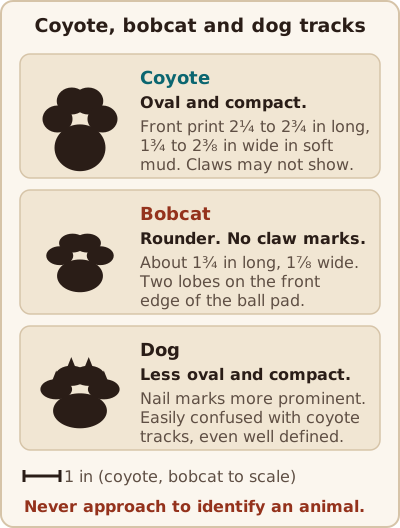
Because dogs and coyotes are both canids and some dogs resemble coyotes, extension sources are careful. NMSU Extension states that some dog tracks can be easily confused with coyote tracks, even when well defined.
What it and UC IPM do say:
| Feature | Coyote | Dog |
|---|---|---|
| Track shape | More oval and compact (NMSU, UC IPM) | Less oval and compact than coyote (NMSU, UC IPM, “common dog breeds”) |
| Trail | Follows a straight line more closely (NMSU) | Wanders more from a straight line (NMSU) |
| Nail marks | Claws may not appear when the print is not in soft ground (NMSU) | Nail marks more prominent (NMSU) |
| Face and tail | Longer, narrower snout; bushy black-tipped tail (UC IPM) | Not described by the sources |
The table says what the sources support and nothing more; there is no dog column for body size, since dogs vary widely. In practice, behavior is the better clue. A coyote that moves away when challenged is acting as AZGFD describes. A loose dog may approach people. If you are unsure whether an animal is a stray dog or a coyote, call animal control; CDC advises calling animal control to remove stray animals from the neighborhood.
Coyote vs bobcat
The best-sourced contrast is in the tracks. NMSU Extension says:
- A typical bobcat track is about 1 3/4 inches long by 1 7/8 inches wide, and rounder than coyote or dog tracks.
- Bobcat tracks show no claw marks.
- The front edge of the bobcat’s ball pad has two lobes, which distinguishes it from the coyote’s.
- Coyote front tracks in soft mud are 2 1/4 to 2 3/4 inches long and 1 3/4 to 2 3/8 inches wide, and are more oval.
For body description, none of the sources we opened describes a bobcat’s appearance, so we do not. We did not capture an AZGFD bobcat species page, so we do not cite one. If you need a bobcat description, check the department’s website directly.
Coyote vs fox
We could not source this one. The NMSU tracks circular states that fox is not covered, and none of the other agency or extension sources we opened compares foxes and coyotes. Common differences you may have read elsewhere, such as size or ear shape, come from sources we are not permitted to use on this site, so we leave them out. For an Arizona fox, check the AZGFD website or call the department. Rabies is a concern for any wild mammal; the CDC page we opened names foxes among species in which rabies is reported in wildlife.
What identification does not change
Whether the animal is a coyote, a fox or a bobcat, the steps that protect people and pets are mostly the same:
- Keep your distance and do not approach, feed or corner it.
- Bring small pets inside or pick them up. AZGFD says to pick up small pets and to protect small children so they do not panic and run.
- Remove food sources, including pet food and unsecured garbage.
- If a pet has had any contact with a wild animal, or anyone has been bitten or scratched, call your doctor or vet and local animal control. The CDC says to wash bites or scratches immediately with soap and water and urgently seek medical attention after possible rabies exposure.
- Report aggressive or unafraid animals to AZGFD.
Tracks, scat and signs
If your identification rests on a print, read coyote tracks, scat and other signs for ranges and the University of Arizona’s cautions about scat. For pet safety, see keeping small dogs safe from coyotes and the pet and child safety hub.
What we could not source
- Coyote vs fox appearance or tracks.
- Bobcat appearance beyond tracks.
- Coyote vs dog size, ear or tail carriage beyond what is quoted above.
- Hybrids, or how to tell a coyote from a mixed-breed dog at a distance.
- Arizona-specific coloration of coyotes.
Related guides
- Coyote information hub
- How local coyotes act
- Coyote tracks, scat and other signs
- Coyote breeding and pup season in Arizona
Emergency numbers if an animal acts aggressively and what AZGFD will and will not do
AZGFD (current Living with Coyotes page and April 2023 news release, both accessed 2026-11-14) says that if a coyote attacks a person, you should report it to the department or call 911, and that anyone who is bitten should seek medical care immediately. Its 24-hour Communications Center for wildlife acting aggressively toward people is 623-236-7201 (confirm before relying on it). If a coyote is approaching or has bitten someone, call 911. For a pet that has been attacked, call your vet first.
AZGFD does not respond to calls to relocate or remove coyotes unless there is a public-safety concern; for removal on private property it points residents to a licensed wildlife-removal business. The news release says predators that attacked people or show predatory or aggressive behavior toward people are removed lethally only as a last resort and cannot be relocated for public-safety reasons, and that removal does not help if attractants remain. Pima Animal Care Center dispatch is 520-724-5900 ext. 4 (pima.gov; confirm before relying on it).
Feeding wildlife (except birds and tree squirrels) is unlawful in Maricopa, Pinal and Pima counties under A.R.S. 13-2927, according to the AZGFD news release; some cities and counties have their own ordinances. Checked on 2026-11-14; confirm with AZGFD and your local animal control.
Frequently asked questions
What does a coyote look like compared with a dog?
University of California IPM says a coyote resembles a small German shepherd, but with a longer, narrower snout and a bushy black-tipped tail, and a coat that is usually a blend of rust to brown to gray. It stands about 18 inches at the shoulder. Because the two are both canids and some dogs look similar, appearance alone can be unreliable, so watch behavior and keep your distance.
How much does a coyote weigh?
AZGFD says Arizona coyotes weigh about 20 to 30 pounds, with males larger (its 2015 brochure said 15 to 30). University of California IPM gives 20 to 35 pounds for males and 18 to 25 for females, and University of Florida IFAS gives 20 to 40 pounds for Florida coyotes. The figures differ by source and region, so use them as a rough range. Do not approach any wild animal to check.
How can I tell coyote tracks from dog tracks?
NMSU Extension says coyote tracks are more oval and compact than dog tracks and follow a straight line more closely, while dog nail marks are more prominent and dog trails wander more. It also states that some dog tracks can be easily confused with coyote tracks even when well defined. University of California IPM similarly calls coyote tracks more oval and compact than most dog breeds.
How do bobcat tracks differ from coyote tracks?
NMSU Extension says a typical bobcat track is about 1 3/4 inches long by 1 7/8 inches wide, rounder than coyote or dog tracks, and shows no claw marks. The front edge of the bobcat's ball pad has two lobes, which distinguishes it from the coyote's. Coyote front tracks in soft mud run 2 1/4 to 2 3/4 inches long by 1 3/4 to 2 3/8 inches wide.
How do I tell a coyote from a fox?
We could not find an Arizona agency or extension source we opened that compares foxes with coyotes in useful detail, and the NMSU tracks circular states that fox is not covered. We will not guess. The AZGFD Living with Coyotes page we captured covers coyotes only, so check azgfd.com directly or call the department if you need help with an identification.
Could the animal I saw be a coyote-dog mix or someone's loose dog?
The sources we opened do not address hybrids. They do say some dog tracks are easily confused with coyote tracks and that a coyote resembles a small German shepherd, so mistakes are possible. If you see an animal near homes that is not behaving like a wary wild animal, keep your distance and call animal control or AZGFD instead of trying to identify it up close.
Does it matter whether it is a coyote, fox or bobcat for pet safety?
Yes and no. AZGFD says coyotes eat house cats and small dogs, among other things, and advises supervising small pets and keeping cats indoors or in a secure enclosure, which also protects them from owls, hawks, cars and domestic dogs. Those steps help regardless of species. For a specific animal near a pet, call your vet and animal control.
Sources
- University of California IPM, Coyote (Pest Notes, 2007) (ipm.ucanr.edu)
- NMSU Cooperative Extension, Identifying and Preserving Wildlife Tracks (CR-561) (pubs.nmsu.edu)
- Arizona Game and Fish Department, Living with Coyotes (azgfd.com, accessed 2026-11-14) (azgfd.com)
- Arizona Game and Fish Department, TIPS to avoid conflicts with coyotes (news release, April 7, 2023; accessed 2026-11-14) (azgfd.com)
- Arizona Game and Fish Department, Living with Coyotes brochure (2015; older document, cited only where noted) (s3.amazonaws.com)
- University of Florida IFAS Extension, Commonly Asked Questions About Coyotes in Florida (ask.ifas.ufl.edu)
- University of Arizona Cooperative Extension, Wildlife Track and Scat Identification (Backyard Gardener #131) (extension.arizona.edu)
Related guides
- Coyote Information for Arizona Homeowners
What agencies and extension services say about urban coyotes in Arizona: what they are, why they come near homes, and rabies and distemper.
- Coyote Behavior in Arizona Neighborhoods
What AZGFD and extension sources say about normal coyote behavior, when it becomes a concern, and what feeding and indifference cause.
- Coyote Breeding and Pup Season in Arizona
What AZGFD and extension sources say about coyote breeding, litter size, dens and pups, why spring needs extra pet care, and what to do near a den.
- Coyote Tracks, Scat and Other Signs
What university extension sources say about coyote track size and shape, why scat identification is hard, and how to stay safe when checking for signs.
- Coyote Sounds: Howls, Yips and What They Mean
Coyote howls, yips and barks in Arizona: what the sounds are, when you hear them, and what the agencies say about hearing coyotes near your home.
- What Urban Coyotes Eat
What coyotes eat in Arizona, from rodents and fruit to garbage, pet food and small pets, and what that means for your yard.